In the past, I have used power calculators like GPower for straightforward research designs, but I have never really found a good, practical resource on executing the mechanics of power simulations, especially when research designs and analytical frameworks are more complex. This great article provides a framework (with R code) to execute power simulations and may be useful to students in Research Seminar (AEM 6991). https://cameronraymond.me/blog/power-simulations-in-r/ . There is also a GitHub posting at https://github.com/cameron-raymond/power-simulation-tutorial.
Potential Student Resources for Data Scraping
Here are a few resources that students may find useful for research seminar projects that involve data scraping. This list of resources may be updated from time to time:
- Practical Introduction to Data Scraping Using Python – https://realpython.com/python-web-scraping-practical-introduction/
- Python, Data Scraping, and Beautiful Soup Crash Course – https://www.youtube.com/watch?v=XVv6mJpFOb0
- Facebook Data Scraping and Sentiment Analysis Using Python – https://www.danielherediamejias.com/facebook-scraping-and-sentiment-analysis-with-python/
- Twitter Data Scraping and Python – https://www.natasshaselvaraj.com/how-to-scrape-twitter/
Message to New and Prospective Students at Cornell University for Applied Behavioral Economics in Finance and Marketing (AEM 6150 – Spring 2022)
Welcome to Applied Behavioral Economics in Finance and Marketing (AEM 6150)!
This new course is geared toward developing knowledge, ability, and professional skills to apply behavioral economics in business settings. The course is especially geared toward students who may consider future professions in consumer finance, marketing, product development, data science, or consulting/advisory. Because this is a 7-week course, I assume that you have some exposure to behavioral science concepts (e.g., AEM 6140 – Behavioral and Managerial Decision Making or equivalent background). If you do not, I have identified some supplemental readings in the syllabus that you should consider reviewing; you should also contact me (sds77@cornell.edu) so that we can better assess whether the course is right for you.
In terms of personal background, I am a new, incoming faculty member at Cornell. I have a non-traditional background and have spent more than 30 years in the corporate world with more than a decade of those years setting up behavioral science units and initiatives in the real world (e.g., nudge units). I continue to work full-time as a consultant and researcher in the behavioral economics space. I especially bring my experience in setting up some of the first nudge units in the world to the design of this course (which includes some cases from companies I have worked with). I am also a Cornell alum who has had a very fortunate career, and so I have a deep attachment to the community here. I would like you to be challenged in this course and succeed in life beyond Cornell. If you would like to learn more about my background, please refer to my bio.
Thank you for considering taking this course. Please feel free to reach out to me via email if you have any questions (sds77@cornell.edu).
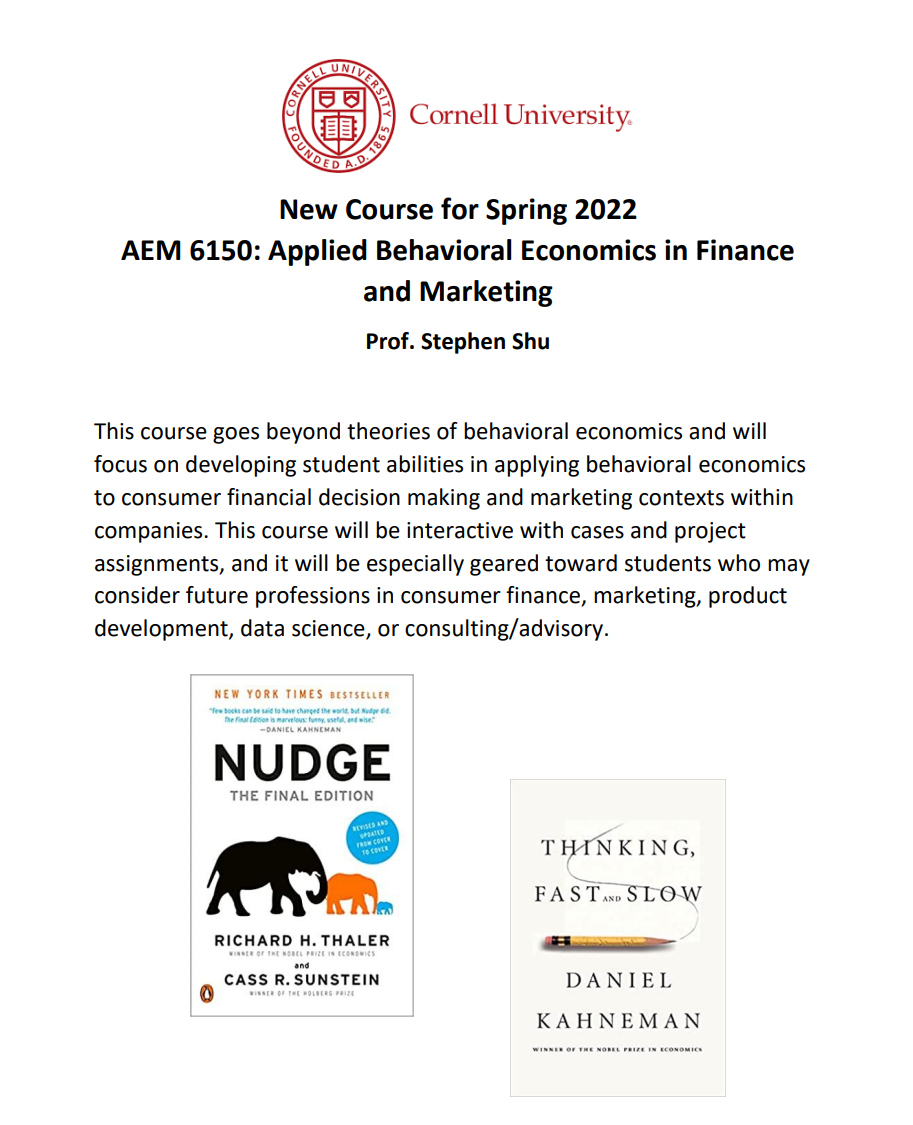
New Course for Spring 2022: Applied Behavioral Economics in Finance and Marketing (AEM 6150)
Things a Consultant Can Do to Increase the Chances of Their Recommendations Being Implemented Successfully by a Client
This post is based on a question that was posed to me on Quora.
Here are a few things to consider for this type of situation:
- See if you can get a resource assigned within the company to take the lead on program managing changes into the organization. Also to help increase the probability of success, see if the incentives of the assigned resources and sponsor can be aligned with the initiative outcomes.
- If you have the skillset and desire, propose extending your contract to potentially help with piloting and incubating the new changes. You could structure your contract to include performance outcomes if you haven’t already done that for the prior phase.
- Potentially partner with another consultant that has experience with implementing changes within an organization. This could become part of a longer-run business model for you.
A Call for the Heterogeneity Revolution in Behavioral Science
This article should be on every modern behavioral science researcher’s reading list for a cohesive view of the future. It will take awhile for the community (both research and applied) to wrap our heads around elevating heterogeneity and context relative to main effects.
Bryan, C.J., Tipton, E. and Yeager, D.S., 2021. Behavioural science is unlikely to change the world without a heterogeneity revolution. Nature Human Behaviour, pp.1-10.
Nice Article and Study on the “Additive Bias”
The additive bias seems like a key reason that websites and apps in the digital world get overly complicated over time with features and elements. See more here:
Optional Reading for AEM 6150 at Cornell University
This is an optional reading for AEM 6150 at Cornell University taught by Stephen Shu. The reading is from Chapter 12 (pages 41-44) of The Consulting Apprenticeship and covers the “key takeaway” titling, a method which is used heavily in consulting.