
Last week in my behavioral economics class, we spent time discussing beliefs and what happens when new information arrives. This process is often referred to as belief updating.
Suppose I hold a particular belief. My natural tendency is to interpret new information in light of that belief. I look for evidence that confirms what I already think.
If information confirms my belief, I am likely to accept it as is. It feels right and requires relatively little mental energy, often engaging what behavioral economists call System 1, or fast thinking.
If information disconfirms my belief, I am less likely to accept it immediately. Instead, I may scrutinize it by asking questions such as:
- “Is the source credible?”
- “Is this just an exception?”
- “Is there another explanation?”
That kind of scrutiny draws more heavily on System 2 – slower, more deliberate thinking that requires more mental effort.
There is something both elegant and troubling about this. Confirming information can be processed quickly and intuitively. Disconfirming information tends to require more deliberate analysis and more mental energy. That energy differential is an important driver of confirmation bias.
Borrowing an insight from the colleague who taught this behavioral economics course before me, the implication is that even randomly generated information can strengthen an existing belief. Information that supports the belief is accepted relatively easily. Information that challenges it is held to a higher standard. As a result, a belief can persist even when new information contradicts the assumptions on which it was originally built.
This should matter to anyone making decisions, especially managers, where the consequences can be amplified across an organization. Confirmation bias can show up in how we think about a current business strategy, a marketing campaign, an app design, a call script, an operational process, or virtually any other established way of doing things.
Of course, sticking with a current process can have benefits. Testing, redesigning, and implementing new processes can be expensive. Not every idea deserves a full-scale experiment.
But what if we had a relatively low-cost way to test counterfactuals? What if we could ask: What might happen if we changed this assumption, message, process, or design?
Tools can potentially help if we use them to challenge our thinking rather than reinforce it with confirmation biases.
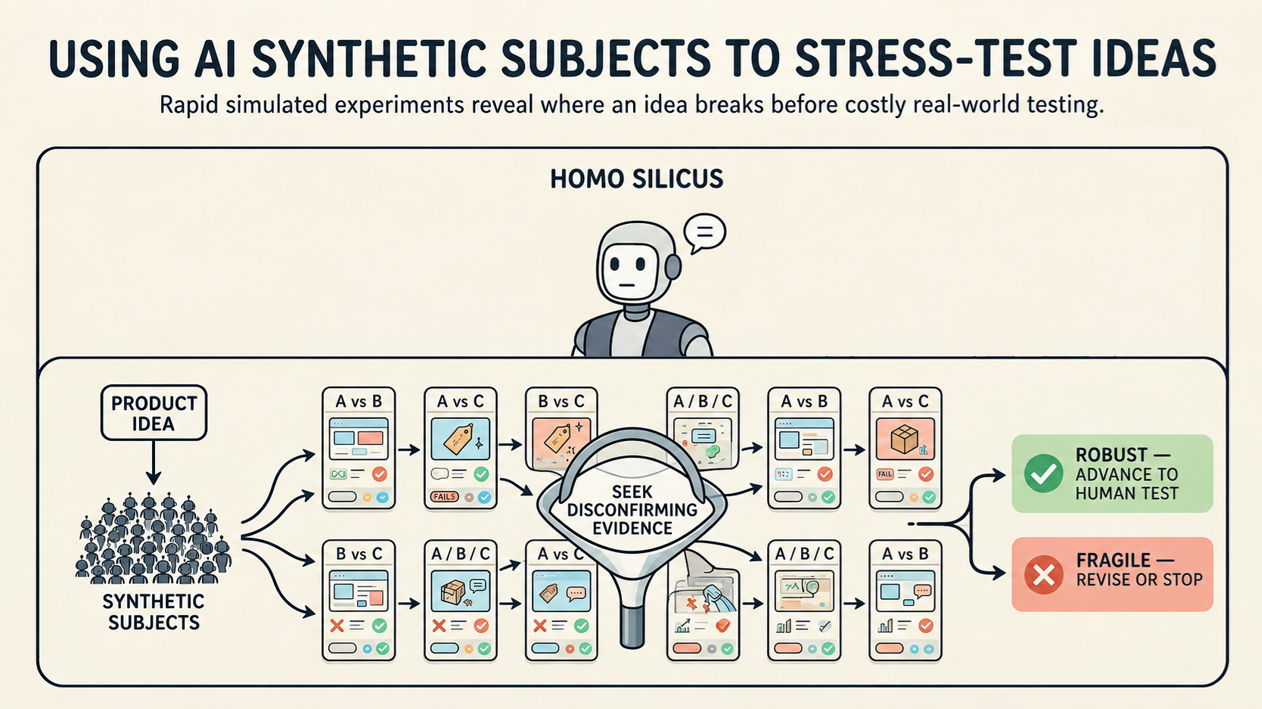
I have been working with students and people in industry to explore A/B-testing ideas using AI synthetic subjects at scale. Used carefully (such as validating or calibrating AI synthetic subjects versus human subjects), these tools can help us rapidly test competing assumptions, explore a wider set of counterfactuals, and search for behavioral interventions that might disconfirm an initial view. Given the pervasive nature of confirmation bias, that process can often uncover opportunities for improvement that we would not otherwise consider.
The point is not to replace judgment. It is to use AI as a tool for testing many possible counterfactuals helping us work within our mental limits while expanding the set of possibilities we are willing to consider.
Image source: Generated using Perplexity by Stephen Shu on September 21, 2026